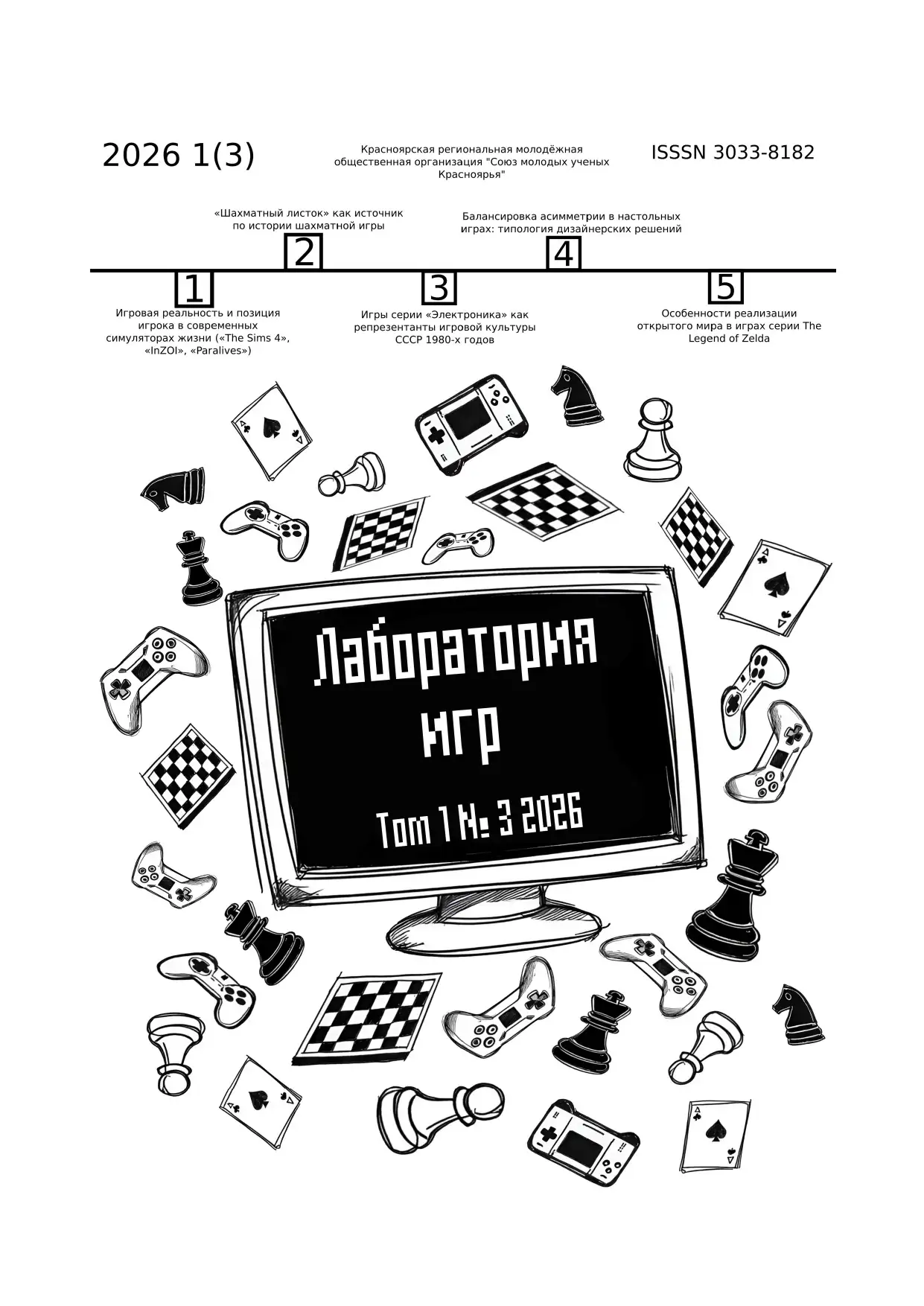
СОДЕРЖАНИЕ ВЫПУСКА
ISSUE CONTENT
Холодкова Л.М.
«ШАХМАТНЫЙ ЛИСТОК» КАК ИСТОЧНИК ПО ИСТОРИИ ШАХМАТНОЙ ИГРЫ
Макарчук И.Ю., Костяева Е.С., Безрукова Л.В.
«CHESS SHEET» AS A SOURCE ONTHE HISTORY OF THE GAMEOF CHESS
Makarchuk I.Yu., Kostyaeva E.S., Bezrukova L.V.
УДК 794:004.946
Холодкова Л.М.¹
¹ Сибирский федеральный университет.
Аннотация. Жанр симулятора жизни в видеоиграх сталмассовым, когда в 2000 году компания «Maxis» выпустила«TheSims» — первую игру будущей франшизы, монополизирующей целый жанр. Вот уже 12 лет «The Sims 4» является единственным востребованным симулятором жизни без серьезных конкурентов. Однако в 2025 и 2026 году появились новые представители жанра — «InZoi» и «Paralives», основной целью которых было создание конкуренции и смещение монополиста с его позиции. Поскольку главной характеристикой любой игры жанра является симуляция уникального сообществаи свободное управление персонажами, ключевыми различиями становится не столько набор доступных игровых механик, сколько отношения экосистемы и человека, с ней взаимодействующего. Основными пунктами сравненияв данном исследовании выступили внутриигровая реальность и положение в ней игрока. Методологическими основаниями стали процедурная риторика Й. Богоста и теория эмерджентного нарратива. В результате исследования было определено, что «The Sims 4» воспроизводит положения процедурной риторикии эмерджентного нарратива наиболее полно. Игра предлагает объемное мироустройство с большим возможностями индивидуального сторителлинга, где пользователь выступает в роли свободного рассказчика. «InZOI» предполагает невыразительную симуляцию сообщества, а механики игры не складываются в полноценный нарратив. Статус игрока также строго определен,его возможности в индивидуализации ограничены. «Paralives» закладывает необходимость соответствовать особенностям жанра RPG, что ограничивает пользователя системой рассказчика. На данный момент у игры нет фундамента для уникального повествования,но есть потенциал для его развития в будущем.
Ключевые слова: СИМУЛЯТОР ЖИЗНИ, ВИДЕОИГРА, ПРОЦЕДУРНАЯРИТОРИКА, ЭМЕРДЖЕНТНЫЙ НАРРАТИВ, ИГРОВЫЕ ИССЛЕДОВАНИЯ.
Kholodkova L.M.¹
¹ Siberian Federal University.
Abstract. The life simulation genre in video games became mainstream in 2000 when Maxis released The Sims — the first game in a franchise that would go on to dominate Life simulation games. For 12 years now, “The Sims 4” has been the only popular game in Life simulation games without any serious competition. However, in 2025 and 2026, new entries in Life simulation games appeared — “InZoi” and “Paralives” — whose main goal was to create competition and displace the market leader from its position. Since the main characteristic of any game in Life simulation games is the simulation of a unique community and free control over characters, the key differences lie not so much in the set of available game mechanics as in the relationship between the ecosystem and the person interacting with it. The main points of comparison in this study were the in-game reality and the player’s position within it. The methodological foundations were based on J. Bogost’s procedural rhetoric and the theory of emergent narrative. The study concluded that “The Sims 4” most fully embodies the principles of procedural rhetoric and emergent narrative. The game offers a rich world with extensive opportunities for individual storytelling, where the user acts as a free narrator. “InZOI” features a bland simulation of a community, and the game’s mechanics do not coalesce into a fully-fledged narrative. The player’s status is also strictly defined, and their options for customization are limited. “Paralives” is designed to adhere to the conventions of the RPG genre, which confines the user to a narrative framework. At this point, the game lacks the foundation for a unique narrative, but it has the potential to develop one in the future.
Keywords: LIFE SIMULATIONGAME, VIDEO GAMES, PROCEDURAL RHETORIC, EMERGENT NARRATIVE, GAME STUDIES.
УДК 316.7
«ШАХМАТНЫЙ ЛИСТОК» КАК ИСТОЧНИК ПО ИСТОРИИ ШАХМАТНОЙ ИГРЫ
Макарчук И.Ю.¹, Костяева Е.С.², Безрукова Л.В.¹
¹ Красноярская средняя школа №78
² Сибирский федеральный университет
Аннотация. Статья посвящена комплексному анализу содержания первого тома журнала «Шахматный листок»за1876 год, изданного под редакцией выдающегося русского шахматиста Михаила Ивановича Чигорина (1850-1908). Рассматриваемый период является основополагающим для становленияотечественнойшахматной школы. М.И. Чигоринпредстает в исследовании как сильнейший игрок своего времени и претендент на мировое первенство, а также как талантливый организатор, наставник и первый профессиональный шахматист России, чья деятельность определила облик последней четвертиXIX столетия, названной исследователями «чигоринским периодом». Центральное место вработе занимает текстологический анализ материалов дебютного года издания. Авторы статьи раскрывают просветительскую концепцию журнала, согласно которой, осознавая конкуренцию со стороны азартных игри поверхностное отношение публики к шахматам как к простому развлечению, Чигорин поставил целью превратить их в объект глубокого научного изучения. Для этого журнал предоставлял читателям доступ к теоретическим основам, правилам, биографическим очеркам и детальному разбору партий отечественных и зарубежных мастеров. В качестве базовой технической схемы для записи ходов была выбрана алгебраическая нотация, что способствовало стандартизации материала. Значительная часть анализа посвящена освещению международной повестки. Журнал знакомил русскую публику с глобальным контекстом, подробно описывая организацию первых международных турниров.
Ключевые слова: М.И. ЧИГОРИН, «ШАХМАТНЫЙ ЛИСТОК», ИСТОРИЯ ШАХМАТ.
«CHESS SHEET» AS A SOURCE ONTHE HISTORY OF THE GAMEOF CHESS
Makarchuk I.Yu.¹, Kostyaeva E.S.², Bezrukova L.V.¹
¹ Secondary School № 78 of Krasnoyarsk
² Siberian Federal University
Abstract. This article presents a comprehensive analysis of the contents of the first volume of the journal Chess sheet for the year 1876, edited by the outstanding Russian chess player Mikhail Ivanovich Chigorin (1850-1908). The period under consideration is fundamental to the development of the Russian school of chess. In this study, M.I. Chigorin is portrayed as the strongest player of his time and a contender for the world championship, as well as a talented organiser, mentor and Russia’s first professional chess player, whose activities shaped the final quarter of the nineteenth century, a period referred to by researchers as the ‘Chigorin period’. The study focuses on a textual analysis of material from the journal’s inaugural year. The authors of the article explore the journal’s educational concept, according to which, recognising the competition from games of chance and the public’s superficial attitude towards chess as mere entertainment, Chigorin set himself the goal of transforming it into a subject of in-depth scholarly study. To this end, the journal provided readers with access to theoretical foundations, rules, biographical sketches and detailed analyses of games played by Russian and foreign masters. Algebraic notation was chosen as the standard method for recording moves, which helped to standardise the material. A significant portion of the analysis was devoted to covering the international scene. The magazine introduced the Russian public to the global context, describing in detail the organisation of the first international tournaments.
Keywords: M.I. CHYGORIN, «CHESSSHEET», HISTORY OF CHESS.
УДК 316.7
ИГРЫ СЕРИИ «ЭЛЕКТРОНИКА» КАК РЕПРЕЗЕНТАНТЫ ИГРОВОЙ КУЛЬТУРЫ СССР 1980-Х ГОДОВ
Ермаков Т.К.¹
¹ Сибирский федеральный университет.
Аннотация. Развитие советских видеоигр в 1980-е годы оказало существенное влияние на формирование российской игровой культуры, что обуславливает значимость исследования данного этапа. Одним из наиболее ярких явлений рассматриваемого периода можно считать игры серии «Электроника», выпускавшиеся с 1984 года. Рассматривая устойчивые признаки игровых систем, конструируемых в данных игровых проектах,можно сделатьнесколько значимых выводов не толькоо характере самихигровых систем,но и обигровойкультуре вообще. Вцелом, игры серии «Электроника» строятся вокруг агентивности игрока, связанной снеобходимостью изменения дискретного состояния внутриигрового объекта. На ранних этапах каждое новое состояние независимо от предшествующих состояний, однако, усложнение игровой системы приводит к появлениюпроектов, вкоторых состояния игрового объекта взаимосвязаны. В результате, происходит усложнение агентивности игрового пространства, которое становится непрерывным и сложно-организованным на уровне репрезентации, что становитсяважным шагом к формированиюигровых систем, не зависящих от возможности их неигрового применения. Такимобразом, игры серии «Электроника» можнорассматриватькак значимый элемент в формировании игровой культуры, понимающей игру как развлечение, не связанное скакойлибо внешней полезностью.
Ключевые слова: ЭЛЕКТРОНИКА, СССР, ВИДЕОИГРА, АРХЕОЛОГИЯ МЕДИА
THE ELEKTRONIKA GAMES SERIES AS REPRESENTATIVES OF 1980S USSR GAMING CULTURE
Ermakov T.K.¹
¹ Siberian Federal University.
Abstract. The development of Soviet video games in the1980s hada significant impact onthe formation of Russiangamingculture, making this period of study particularly important. Among the most striking phenomenaof this period are the Elektronika seriesof games, releasedbeginningin 1984. By examining the consistent features ofthe game systems constructed inthese projects, several significant conclusions canbe drawnnot only about the nature of the game systems themselves but also about gamingculture ingeneral. In general, Elektronikagamesare built around player agency, whichis associatedwiththe need to change the discrete state of anin-game object. In the early stages, eachnew state is independent of previous states; however, as the game system becomes more complex,projects emerge in which the states ofthe game object are interconnected. As a result,the agency of the game space becomes increasingly complex,becoming continuousandintricately organizedat the representational level, marking an important step toward the formationofgame systems independent of their non-game applications. Thus, the games ofthe «Elektronika» series can be considered a significant element inthe formationofa gamingculture that understandsgamingas entertainment not associated withany external utility.
Keywords: ELEKTRONIKA, USSR, VIDEO GAME, MEDIA ARCHAEOLOGY.
УДК 794.05
БАЛАНСИРОВКА АСИММЕТРИИ В НАСТОЛЬНЫХ ИГРАХ: ТИПОЛОГИЯ ДИЗАЙНЕРСКИХ РЕШЕНИЙ
Гомонов И.С.¹
¹ Сибирский федеральный университет.
Аннотация. Статья посвящена проблеме балансировки асимметричных настольных игр — одного из заметных направлений современного геймдизайна, в котором участники обладают структурно различающимися стартовыми условиями, способностями, целями, правилами, информацией или возможностями взаимодействия с игровой системой. Актуальность исследования определяется противоречием между необходимостью сохранять содержательную и механическую уникальность сторон и риском возникновения структурного преимущества, способного снизить соревновательную ценность игры. Цель статьи заключается в систематизации дизайнерских стратегий компенсации асимметрии и построении рабочей типологии механизмов её балансировки. Теоретическую основу исследования составляют существующие подходы к классификации асимметрии, включая модель MDA и расширенные типологии, а также разграничение объективного и субъективного понимания игрового баланса. Эмпирическую основу составляет сравнительный качественный анализ четырёх настольных игр — Magical Athlete, Root, Arcs и Мор.Утопия, отобранных по принципу методологического контраста. Такой подход позволяет рассмотреть принципиально различные способы компенсации структурного неравенства и определить границы применимости отдельных дизайнерских решений. Анализ показывает, что балансировка асимметрии не сводится к количественному выравниванию характеристик сторон и может осуществляться на разных этапах игрового процесса. На основании рассмотренных примеров выделяются пять взаимодополняющих механизмов: балансировка посредством процедуры выбора, структуры победных условий, модульности правил, эмерджентной системы целей и компенсации информационного и временного превосходства. Показано, что данные механизмы способны сочетаться в рамках одной игры и формировать многоуровневую систему поддержания игрового равновесия. Предложенная типология рассматривается как рабочая аналитическая модель, требующая дальнейшей проверки на расширенном корпусе игр с привлечением количественных данных о распределении побед и эмпирических данных о восприятии баланса игроками.
Ключевые слова: НАСТОЛЬНЫЕ ИГРЫ, АСИММЕТРИЯ, ГЕЙМДИЗАЙН, РУТ, МАГИКАЛ АТЛЕТ, АРКС, УТОПИЯ.
BALANCING ASYMMETRY IN BOARD GAMES: TYPOLOGY OF DESIGN SOLUTIONS
Gomonov I.S.¹
¹ Siberian Federal University.
Abstract. The article is devoted to the problem of balancing asymmetric board games — one of the notable trends in modern game design, in which participants have structurally different starting conditions, abilities, goals, rules, information, or opportunities to interact with the game system. The relevance of the study is determined by the contradiction between the need to preserve the substantive and mechanical uniqueness of the sides and the risk of the emergence of a structural advantage that could reduce the competitive value of the game. The aim of the article is to systematize the design strategies for compensating for asymmetry and to build a working typology of mechanisms for balancing it. The theoretical foundation of the study consists of existing approaches to the classification of asymmetry, including the MDA model and extended typologies, as well as the distinction between objective and subjective understanding of game balance. The empirical foundation is based on a comparative qualitative analysis of four board games — Magical Athlete, Root, Arcs, and Pathologick — selected according to the principle of methodological contrast. This approach allows us to examine fundamentally different ways of compensating for structural inequality and to determine the limits of applicability of individual design solutions. Analysis shows that balancing asymmetry is not limited to quantitative equalization of the parties’ characteristics and can be carried out at different stages of the gameplay. Based on the examples considered, five complementary mechanisms are identified: balancing through a selection procedure, the structure of winning conditions, the modularity of rules, an emergent system of goals, and compensation for informational and temporal superiority. It is shown that these mechanisms can be combined within a single game and form a multi level system for maintaining game balance. The proposed typology is considered a working analytical model that requires further validation using an expanded corpus of games, incorporating quantitative data on win distribution and empirical data on players’ perception of balance.
Keywords: BOARD GAMES, ASYMMETRY, GAME DESIGN, ROOT, MAGICAL ATHLETE, ARCS, PATHOLOGICK.
УДК 794:004.946
ОСОБЕННОСТИ РЕАЛИЗАЦИИ ОТКРЫТОГО МИРА В ИГРАХ СЕРИИ THE LEGEND OF ZELDA
Лёвочко Н.М.¹
¹ Сибирский федеральный университет.
Аннотация. Создание обширных однопользовательских игр неизменно ставит перед разработчиками вопрос о реализации открытого мира. Первая часть проблемы — действительно ли его создание необходимо для игрового пространства, вторая — как его сделать не просто фоновым и пустым набором 3D моделей, а многогранной площадкой с ощущением влияния. Пожалуй, одними из главных претендентов на здравый ориентир реализации открытого мира как игрового являются последние части серии игр The Legend of Zelda — Breath of the Wild и Tears of the Kingdom. Breath of the Wild смогла сформулировать в себе основные принципы реализации открытого мира в современном понимании как эталонный образец исследовательского полигона. Стремление воссоздать наполненный событиями и возможностями открытый мир прослеживается с самой первой части серии — предтечей стали сменяющиеся экраны без строгого порядка прохождения. Исходя из этого, можно выделить проблематику особенностей реализации открытого мира и проследить закономерный прогресс на примерах различных частей игры, опыт разработки которых смог эволюционировать в исследовательскую составляющую Breath of the Wild и экспериментаторскую в Tears of the Kingdom.
Ключевые слова: ОТКРЫТЫЙ МИР, ИГРОВАЯ МЕХАНИКА, ЛЕГЕНДА ЗЕЛЬДЫ.
FEATURES OF THE OPEN-WORLD IMPLEMENTATION IN THE LEGEND OF ZELDA SERIES
Levochko N.M.¹
¹ Siberian Federal University.
Abstract. Creating expansive single-player games inevitably poses the question of open-world implementation for developers. The first part of the problem is whether its creation is truly necessary for the gameplay space; the second is how to make it more than just a background and empty set of 3D models, but a multifaceted platform with a sense of impact. Perhaps the most promising contenders for a sound benchmark for implementing an open world as a game are the latest installments of The Legend of Zelda series — Breath of the Wild and Tears of the Kingdom. Breath of the Wild successfully articulated the core principles of open-world implementation in the modern sense, serving as a benchmark for exploration. The desire to recreate an open world filled with events and possibilities can be traced back to the very first game in the series — the precursor was the rotating screens without a strict progression order. Based on this, we can identify the challenges of open-world implementation and trace the logical progression through examples from various parts of the game, the development experience of which evolved into the exploratory component of Breath of the Wild and the experimental component of Tears of the Kingdom.
Keywords: OPENWORLD, GAME MECHANICS, THE LEGEND OF ZELDA.
ВЕРНУТЬСЯ К СОДЕРЖАНИЮ | BACK TO THE CONTENTS