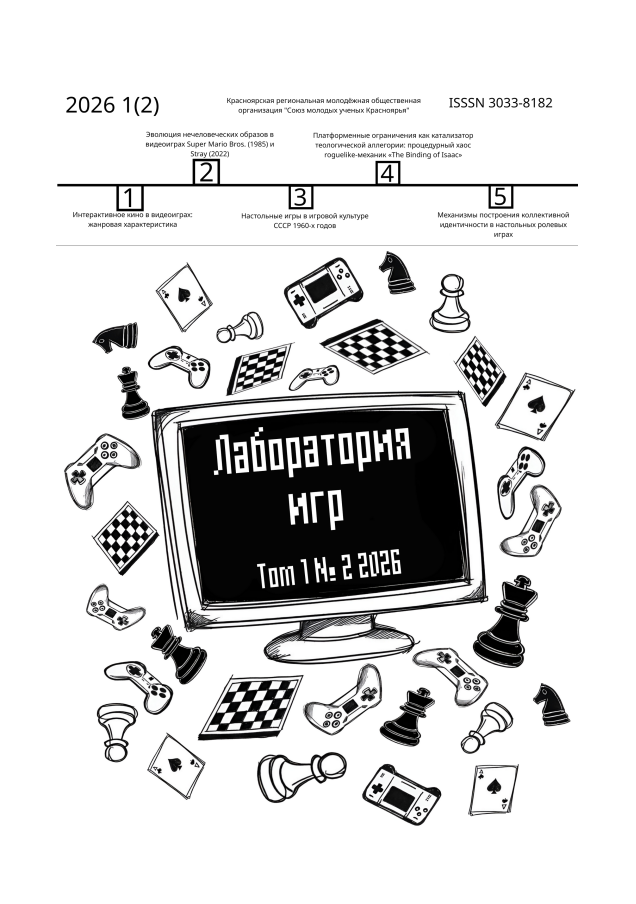
СОДЕРЖАНИЕ ВЫПУСКА
ISSUE CONTENT
ИНТЕРАКТИВНОЕ КИНО В ВИДЕОИГРАХ: ЖАНРОВАЯ ХАРАКТЕРИСТИКА
Лизавета Мариновна Холодкова
INTERACTIVE FILM IN VIDEO GAMES: A GENRE ANALYSIS
Lizaveta M. Kholodkova
ЭВОЛЮЦИЯ НЕЧЕЛОВЕЧЕСКИХ ОБРАЗОВ В ВИДЕОИГРАХ SUPER MARIO BROS. (1985) И STRAY (2022)
Варвара Олеговна Лебедева
Evolution of non-human images in video games Super Mario Bros
Varvara O. Lebedeva
НАСТОЛЬНЫЕ ИГРЫ В ИГРОВОЙ КУЛЬТУРЕ СССР 1960-Х ГОДОВ
Тихон Константинович Ермаков
BOARD GAMES IN GAME CULTURE OF USSR IN THE 1960S
Tikhon K. Ermakov
МЕХАНИЗМЫ ПОСТРОЕНИЯ КОЛЛЕКТИВНОЙ ИДЕНТИЧНОСТИ В НАСТОЛЬНЫХ РОЛЕВЫХ ИГРАХ
Гомонов Илья Сергеевич, Тамилин Роман Викторович
MECHANISMS FOR BUILDING COLLECTIVE IDENTITY IN TABLETOP ROLE-PLAYING GAMES
Ilya S. Gomonov, Roman V. Tamilin
УДК 7.01:004.9
ИНТЕРАКТИВНОЕ КИНО В ВИДЕОИГРАХ: ЖАНРОВАЯ ХАРАКТЕРИСТИКА
Лизавета Мариновна Холодкова1
1 Сибирский федеральный университет, Красноярск, Россия.
lizavetakholodkova@gmail.com
Аннотация. Интерактивное кино – гибридный вид медиума, находящийся на стыке игровой и киноиндустрий. Проекты, реализованные в пределах такого типа медиа, сложно охарактеризовать и классифицировать. В рамках данного исследования осуществляется попытка описать специфические особенности жанра интерактивное кино в видеоиграх, что позволит обозначить границы жанровых особенностей феномена, а также провести параллель между играми и другими медиапродуктами.
Первостепенно рассмотрены грани понятия «интерактивное кино» и дано общее определение, в котором ключевым оказалась возможность реципиента быть не только зрителем или игроком, но и тем, кто развертывает повествование и нарратив. Также были зафиксированы основные предшественники жанра в видеоиграх и их особенности: FMV-игры; графические квесты (Point-and-Click Adventures); визуальные новеллы; ролевые игры (RPG).
Основным результатом исследования стала жанровая характеристика интерактивного кино в видеоиграх, специфику которого складывают: интерактивность; разветвленное повествование и сопряженные с ним акцентные финалы, а также статистика выборов; аудиовизуальная и эстетическая компонента как основа нарративного каркаса; кат-сцены разной направленности как полноценная часть геймплея; QTE – ключевая механика; интеграция классических и уникальных игровых механик. Определено, что все жанровые элементы интерактивного кино работают на складывание качественного нарратива, который воспроизводит уникальную автономную художественную систему, воспринимающую человека как соавтора.
Ключевые слова: интерактивное кино, видеоигры, game studies.
Для цитирования: Холодкова Л. М. Интерактивное кино в видеоиграх: жанровая характеристика // Лаборатория игр. – 2026. – Т. 1. – № 2. – С. 6-14. – EDN: JVWCEH.
INTERACTIVE FILM IN VIDEO GAMES: A GENRE ANALYSIS
Lizaveta M. Kholodkova1
1 Siberian Federal University, Krasnoyarsk, Russia.
lizavetakholodkova@gmail.com
Abstract. Interactive Film is a hybrid medium situated at the intersection of the gaming and film industries. Projects developed within this medium are difficult to characterize and classify. This study attempts to describe the specific characteristics of the interactive film genre in video games, which will help define the boundaries of the genre’s features and draw parallels between games and other media products.
First and foremost, the boundaries of the concept of “Interactive Film” are examined, and a general definition is provided, in which the key feature is the recipient’s ability to be not only a viewer or player, but also the one who unfolds the story and narrative. The main precursors of the genre in video games and their characteristics were also identified: FMV games; graphic adventure games (Point-and-Click Adventures); visual novels; role-playing games (RPGs).
The main result of the study was a genre analysis of interactive film in video games, the specific features of which include: interactivity; branching narratives and the associated multiple endings and choice statistics; audiovisual and aesthetic components as the foundation of the narrative framework; cutscenes of various types as an integral part of gameplay; QTE –a key mechanic; and the integration of classic and unique game mechanics. It has been established that all the genre elements of interactive film contribute to the creation of a high-quality narrative that reproduces a unique, self-contained artistic system that treats the viewer as a coauthor.
Keywords: interactive film, video games, game studies.
For citation: Kholodkova L. M. Interactive Film in Video Games: A Genre Analysis // Game Laboratory, 2026, 1 (2), рр. 6-14. [in Russian]. EDN: JVWCEH.
УДК 7.046:004.92
ЭВОЛЮЦИЯ НЕЧЕЛОВЕЧЕСКИХ ОБРАЗОВ В ВИДЕОИГРАХ SUPER MARIO BROS. (1985) И STRAY (2022)
Варвара Олеговна Лебедева1
1 Сибирский федеральный университет» Красноярск, Россия.
voletdaile0110@gmail.com
Аннотация. Статья посвящена выявлению и анализу эволюции нечеловеческих персонажей в видеоиграх. В статье представлен сравнительный анализ нечеловеческих образов в видеоиграх Super Mario Bros. (1985) и Stray (2022), репрезентирующих разные этапы развития игровой индустрии, разделенные тридцатьюсемью годами технического и нарративного прогресса. Цель исследования – проследить эволюцию подходов к конструированию нечеловеческих персонажей от аркадных механик к нарративно насыщенным мирам. Теоретическую основу работы составили концепции агентности Б. Боди, а также методология формального анализа П. Ланкоски и С. Бьорка. Материалом послужили сами игры, изученные методом включённого наблюдения с последующим формальным анализом по десяти критериям: роль в игровой системе, субъектность (агент / компонент), перечень действий, наличие собственной цели, уникальность, визуальная и аудиальная репрезентация, автономность от игрока, идентификация (личное имя / видовое название), наличие предыстории. Установлено, что в Super Mario Bros. нечеловеческие персонажи являются преимущественно функциями геймплея: они лишены предыстории, существуют только в пределах экрана и не обладают собственными целями. В Stray, напротив, нечеловеческие персонажи наделены агентностью: имеют имена, биографии, социальные роли и персональные цели, не зависящие от игрока. Визуальный код в Stray становится носителем смысла, а игровой мир – автономной средой, существующей независимо от присутствия игрока. Сделан вывод, что эволюция нечеловеческих образов отражает общий вектор развития индустрии: от технически ограниченных аркадных механик к нарративно насыщенным мирам, где каждый персонаж обладает собственной историей.
Ключевые слова: видеоигры, нечеловеческие образы, агентность, Super Mario Bros., Stray, эволюция персонажей.
Для цитирования: Лебедева В. О. Эволюция нечеловеческих образов в видеоиграх Super Mario Bros. (1985) и Stray (2022) // Лаборатория игр – 2026. – Т. 1. – № 2. – С. 15-23. – EDN: OWQLOW.
Evolution of non-human images in video games Super Mario Bros. (1985) and Stray (2022)
Varvara O. Lebedeva1
1 Siberian Federal University, Krasnoyarsk, Russia.
voletdaile0110@gmail.com
Abstract. This article identifies and analyzes the evolution of non-human characters in video games. It presents a comparative analysis of non-human characters in the video games Super Mario Bros. (1985) and Stray (2022), which represent different stages of the gaming industry’s development, separated by thirty-seven years of technical and narrative progress. The aim of the study is to trace the evolution of approaches to constructing non-human characters from arcade mechanics to narratively rich worlds. The theoretical basis of the work comprises B. Bodi’s concepts of agency and the formal analysis methodology of P. Lankoski and S. Björk. The research material consisted of the games themselves, studied through participant observation followed by formal analysis according to ten criteria: role in the game system, subjectivity (agent/component), list of actions, presence of an own goal, uniqueness, visual and audio representation, autonomy from the player, identification (personal name/species name), and presence of a backstory. It was established that in Super Mario Bros. nonhuman characters are primarily gameplay functions: they lack backstories, exist only within the screen boundaries, and do not possess their own goals. In Stray, by contrast, non-human characters are endowed with agency: they have names, biographies, social roles, and personal goals independent of the player. The visual code in Stray becomes a carrier of meaning, and the game world becomes an autonomous environment that exists independently of the player’s presence. It is concluded that the evolution of non-human characters reflects the industry’s overall developmental trajectory: from technically limited arcade mechanics to narratively rich worlds where every character has their own story.
Keywords: video games, non-human images, agency, Super Mario Bros., Stray, character evolution.
For citation: Lebedeva V. O Evolution of non-human images in video games Super Mario Bros. (1985) and Stray (2022) // Game Laboratory, 2026, 1 (2), рр. 15-23. [in Russian]. EDN: OWQLOW.
УДК 316.7
НАСТОЛЬНЫЕ ИГРЫ В ИГРОВОЙ КУЛЬТУРЕ СССР 1960-Х ГОДОВ
Тихон Константинович Ермаков1
1 Сибирский федеральный университет», Красноярск, Россия.
erm-tihon@mail.ru, orcid.org/0000-0002-6967-8720
Аннотация. Развитие проблемного и методологического поля игровых исследований связано с расширением предметности, включающей в себя не только видеоигры, но и настольные игры. В частности, особенно актуальными становятся исследования, в которых игровая культура осмысляется в её целостности, что позволяет понять логику взаимодействия различных игровых практик. Обращение к российской игровой культуре, в этом смысле, представляет особенный интерес, в связи с её значимостью для понимания современного культурного процесса. Формальный анализ некоторых настольных игр, выпущенных в СССР в 1960-е годы, позволяет обрисовать общий контур советской игровой культуры рассматриваемого периода. Во-первых, большая часть игр ориентирована на детскую аудиторию и связаны с образовательными задачами. Во-вторых, многие проекты стирают границу между «игрой» и «игрушкой», что приводит к созданию игровых практик, взаимодействие в рамках которых может быть менее формальным. В-третьих, некоторые игры нацелены на создание комплексных «игровых миров», позволяющих создавать эффект погружения игрока в иную реальность, что достигается с помощью неординарного сочетания игровых механик и особого типа визуальной репрезентации.
Ключевые слова: настольные игры, игровая культура, СССР, формальный анализ игр.
Для цитирования: Ермаков Т. К. Настольные игры в игровой культуре СССР 1960-х годов // Лаборатория игр. – 2026. – Т. 1. – № 2. – С. 24-29. – EDN: SMMLAM.
BOARD GAMES IN GAME CULTURE OF USSR IN THE 1960S
Tikhon K. Ermakov1
1 Siberian Federal University, Krasnoyarsk, Russia.
erm-tihon@mail.ru, orcid.org/0000-0002-6967-8720
Abstract. The development of the problematic and methodological field of game studies is associated with the expansion of its subject matter, encompassing not only video games but also board games. In particular, studies that conceptualize game culture in its entirety are becoming particularly relevant, allowing for an understanding of the logic of interaction between various game practices. In this regard, examining Russian game culture is of particular interest due to its significance for understanding contemporary cultural processes. A formal analysis of some board games released in the USSR in the 1960s allows us to outline the general contours of Soviet game culture during this period. Firstly, the majority of games are aimed at children and are associated with educational objectives. Secondly, many projects blur the boundaries between «game» and «toy,» leading to the creation of game practices within which interactions can be less formal. Third, some games aim to create complex «game worlds» that allow the player to immerse themselves in another reality, which is achieved through an unusual combination of game mechanics and a special type of visual representation.
Keywords: board games, gaming culture, the USSR, formal game analysis.
For citation: Ermakov T. K. Board games in game culture of USSR in the 1960s // Game Laboratory, 1 (2), рр. 24-29. [in Russian]. EDN: SMMLAM.
УДК 79.01/.09
Дарья Анатольевна Нимаева1
1 Сибирский федеральный университет, Красноярск, Россия.
nimaevadara9@gmail.com
Аннотация. Статья посвящена анализу цифровой игры «The Binding of Isaac» как культурного, технологического и платформенно обусловленного медиума. Исследовательская проблема формулируется в поле digital humanities, исследований цифровой культуры и искусства. Необходимо показать, что платформа не является нейтральной средой существования игры: ее материальнотехнические, программные, интерфейсные и дистрибутивные параметры участвуют в формировании эстетики, механики, пользовательского опыта и интерпретационных режимов. Цель работы заключается в выявлении отношения между платформой Adobe Flash и связанной с ней веб-экосистемой, определявшие форму оригинальной версии «The Binding of Isaac», ответив также на вопрос: как эти ограничения превращались в значимую часть игрового смысла? Методологическую основу исследования составляет платформенный анализ в трактовке Я. Богоста и Н. Монтфорта, дополненный сравнительным анализом оригинальной Flash-версии игры и переиздания (Rebirth). Материалом исследования выступают оригинальная версия игры «The Binding of Isaac» (2011), ее переиздание «The Binding of Isaac: Rebirth» (2014), а также корпус научных работ по теории игр, процедурности, цифровой религии и медиаархеологии Flash. В результате показано, что платформенные ограничения Flash не только влияли на техническую реализацию проекта, но и структурировали его визуальный режим, темп взаимодействия, повторяемость прохождений, характер случайности и способы пользовательского участия. Это позволяет рассматривать игру как пример того, как цифровизация культуры проявляется в платформенной обусловленности художественной формы и в сопряжении кода, интерфейса, дистрибуции и символического содержания.
Ключевые слова: цифровая игра, digital humanities, цифровизация культуры, platform studies, The Binding of Isaac, Adobe Flash.
Для цитирования: Нимаева Д. А. Платформенные ограничения как катализатор теологической аллегории: процедурный хаос roguelike-механик «The Binding of Isaac» в методологии Иена Богоста // Лаборатория игра. – 2026. – Т. 1. – № 2. – С. 30-36. – EDN: CZQWIS.
Daria A. Nimaeva1
1 Siberian Federal University, Krasnoyarsk, Russia.
nimaevadara9@gmail.com
Abstract. The article is devoted to the analysis of the digital game «The Binding of Isaac» as a cultural, technological, and platform-specific medium. The research problem is formulated in the field of digital humanities, digital culture studies, and art studies. It is necessary to show that the platform is not a neutral medium for the game’s existence; its material, technical, software, interface, and distribution parameters contribute to the formation of aesthetics, mechanics, user experience, and interpretive modes. The purpose of the work is to identify the relationship between the Adobe Flash platform and the related web ecosystem that defined the form of the original version of The Binding of Isaac, as well as to answer the question of how these limitations became a significant part of the game’s meaning. The study is based on platform analysis as defined by J. Bogost and N. Montfort, complemented by a comparative analysis of the original Flash version of the game and its re-release (Rebirth). The study is based on the original version of «The Binding of Isaac» (2011), its re-release «The Binding of Isaac: Rebirth» (2014), and a body of academic works on game theory, procedurality, digital religion, and Flash media archaeology. The study shows that the platform limitations of Flash not only influenced the technical implementation of the project, but also structured its visual mode, interaction pace, replayability, randomness, and user engagement. This allows us to consider the game as an example of how the digitalization of culture manifests itself in the platform-based nature of artistic form and in the interplay of code, interface, distribution, and symbolic content.
Keywords: digital game, digital humanities, digitalization of culture, platform studies, The Binding of Isaac, Adobe Flash.
For citation: Nimaeva D. A. Platform restrictions as a catalyst for theological allegory: roguelike-mechanics of «The Binding of Isaac» in Ian Bogost’s methodology // Game Laboratory, 2026, 1 (2), рр. 30-36. [in Russian]. EDN: CZQWIS.
УДК 794:316.6
МЕХАНИЗМЫ ПОСТРОЕНИЯ КОЛЛЕКТИВНОЙ ИДЕНТИЧНОСТИ В НАСТОЛЬНЫХ РОЛЕВЫХ ИГРАХ
Гомонов Илья Сергеевич1, Тамилин Роман Викторович2
1 Сибирский федеральный университет», Красноярск, Россия.
gomonov.ilya00@mail.ru, orcid.org/0009-0008-3395-5926
2 Красноярский художественный музей имени В.И. Сурикова, Красноярск, Россия.
rvtamilin@gmail.com, orcid.org/0009-0009-0490-844X
Аннотация. Настоящая статья посвящена исследованию механизмов производства коллективной идентичности в настольных ролевых играх (НРИ). Предпосылкой исследования служит наблюдение о том, что игровые группы устойчиво формируют выраженное «чувство мы», не объяснимое ни общностью правил, ни совпадением индивидуальных предпочтений участников. Цель работы – теоретически описать и аналитически проверить на материале механизмы, посредством которых малая игровая группа конституирует свою коллективную идентичность.
В качестве основной теоретической рамки избрана модель коллективного интеллекта Пьера Леви, согласно которой коллектив конституируется не через разделение общего содержания, но через координацию различий. Модель Леви сопоставляется с теорией социальной идентичности Тэшфела и Тёрнера, концепцией нарративной идентичности Рикёра; обосновывается её преимущество в онтологическом, темпоральном и практическом измерениях. Методологически работа представляет собой качественный теоретико-аналитический кейс-анализ трёх игровых систем – Dungeons & Dragons 5 издания, Blades in the Dark и систем, обходящихся без роли мастера-медиатора Fiasco и Ironsworn (вместе).
Основные результаты показывают, что коллективная идентичность производится через соавторство нарратива и накопление «нарративного осадка», а конкретные механики системы выступают активными, а не нейтральными агентами этого процесса. D&D 5e формирует идентичность через функциональную взаимозависимость, Blades in the Dark – через прямую механическую институционализацию коллективности, системы без участия мастеров – через альтернативные режимы нарративной координации.
Новизна исследования состоит в применении модели Леви к анализу НРИ и в демонстрации того, что коллективная идентичность является не побочным эффектом, но структурным инвариантом игровой практики, реализуемым через различные конфигурации координации.
Ключевые слова: настольные ролевые игры, коллективная идентичность, коллективный интеллект, нарративное соавторство, игровые механики, Пьер Леви.
Для цитирования: Гомонов И.С., Тамилин Р.В. Механизмы построения коллективной идентичности в настольных ролевых играх // Лаборатория игр. – 2026. – Т. 1. – № 2. – С. 37-45. – EDN: VLLQUX.
MECHANISMS FOR BUILDING COLLECTIVE IDENTITY IN TABLETOP ROLE-PLAYING GAMES
Ilya S. Gomonov1 , Roman V. Tamilin2
1 Siberian Federal University, Krasnoyarsk, Russia.
gomonov.ilya00@mail.ru, orcid.org/0009-0008-3395-5926
2 Krasnoyarsk V.I. Surikov Art Museum, Krasnoyarsk, Russian Federation.
rvtamilin@gmail.com, orcid.org/0009-0009-0490-844X
Abstract. This article is devoted to the study of the mechanisms of collective identity production in tabletop roleplaying games (RPG). The premise of the study is the observation that gaming groups consistently form a pronounced «sense of us», which is not explained by either the commonality of rules or the coincidence of individual preferences of participants. The purpose of the work is to theoretically describe and analytically test the mechanisms by which a small gaming group establishes its collective identity.
Pierre Levy’s model of collective intelligence was chosen as the main theoretical framework, according to which the collective is constituted not through the division of common content, but through the coordination of differences. The Levy model is compared with the Taschfell and Turner theory of social identity, and the Ricoeur concept of narrative identity; its advantage in ontological, temporal and practical dimensions is substantiated. Methodologically, the work is a qualitative theoretical and analytical case analysis of three game systems – Dungeons & Dragons 5th edition, Blades in the Dark, and systems that dispense with the role of master mediator Fiasco and Ironsworn (together).
The main results show that collective identity is produced through the co-authorship of narrative and the accumulation of «narrative sediment», and the specific mechanics of the system act as active rather than neutral agents of this process. D&D 5e forms identity through functional interdependence, Blades in the Dark – through direct mechanical institutionalization of collectivity, systems without the participation of masters – through alternative modes of narrative coordination.
The novelty of the research lies in the application of the Levy model to the analysis of NRI and in demonstrating that collective identity is not a side effect, but a structural invariant of game practice, implemented through various coordination configurations.
Keywords: tabletop role-playing games, collective identity, collective intelligence, narrative coauthorship, game mechanics, Pierre Lévy.
For citation: Gomonov I.S., Tamilin R.V. Mechanisms for Building Collective Identity in Tabletop Role-Playing Games // Game Laboratory, 2026, 1 (2), рр. 37-45. [in Russian]. EDN: VLLQUX.
ВЕРНУТЬСЯ К СОДЕРЖАНИЮ | BACK TO THE CONTENTS